Pre-production
notes
Aim: to create a
short documentary sequence representing a portrait of a place, capturing the
spirit and feel of the place as well as what happens there.
Chosen location:
my flat in Whitechapel, conveying a sense of the sadness I felt while my
husband was away in hospital for several months; using creative ‘licence’ to
make things look more dismal than they were – need to be very selective about
what is shown.
Shot list
- Gate with spider webs
- Hanging basket
- Pond pump
- Dead plant on ground
- Buckets
- Bird feeder
- Shed to wheelchair (panning)
- Electricity box
- Mantelpiece (panning)
- Bathroom chair (half-hidden)
- Clock
- Hallway (me walking past then towards camera)
- Fridge (wine)
- Drainer (glass)
- Pouring wine
- Sink (dripping)
- Bean can into sink
- On sofa watching TV
- In bed
- Getting up
- Empty bed
- Sitting on bed
- Close-up of blinds
Rejected shots
(due to time constraints):
Water bowl
Tatty sunflower
leaves
Blanket on
washing line
Dying palm leaf
View to closed
door down hallway
Pan of lounge
walls
Close up of gas
box
Close up of
boiler lights
Sink in bathroom
Taking the wine
away
Light pull in
bathroom being turned off
Chart of narrative structure
Storyboards


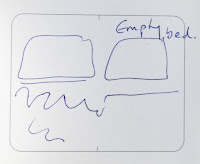
The final sequence
Evaluation
This short film
represents a portrait of my home during the long period of time while my
husband was in hospital in Oxford. He
developed life-threatening septicaemia from a bone infection last September and
has only recently been discharged.
I adore our
small, bohemian flat but was surprised to find very little comfort in my environment
without him. During this time I came
across Philip Larkin’s poem, Home is so
sad, which gave me the idea for the title and theme of the project.
Home is
so sad. It stays as it was left,
Shaped
to the comfort of the last to go
As if to
win them back. Instead, bereft
Of
anyone to please, it withers so,
Having
no heart to put aside the theft
And turn
again to what it started as,
A joyous
shot at how things ought to be,
Long
fallen wide. You can see how it was:
Look at
the pictures and the cutlery.
The
music in the piano stool. That vase.
My main
visual inspiration for this assignment was Yellow Patch by Zarina Bhimji
(2011). According to one critic: “… within the empty spaces of elegant decay
she depicts, I see the patina of people and the breadth of existence that it
would be hard to find in a hundred straightforward stories or cinematic
clichés.” I was mesmerised by this work. It really forced me to slow down and
think about what the artist was trying to convey.
Our flat
is very colourful, alive and inviting so it was quite a challenge to depict the
space as anything less than vibrant and cosy. I wanted to establish an
atmosphere of loneliness and neglect and so selected dead plants, stagnant
water, and an empty bird feeder. I filmed these close up and with shallow depth
of field to accentuate the feeling of isolation and abandonment and to
encourage the viewer to contemplate the sadness of the moment.
The
wheelchair under a tarp on the deck gives the first real clue that, while the
space is inhabited, someone is absent.
The ambient city noises reinforce the sense of solitude whilst life goes
on outside. The camera focuses on the
passage of time with the (hardly moving) electricity meter and the clock. Cut
to photos of us as a couple on the wall, as I arrive home to a silent
flat. The empty fridge and my immediate
beeline to the wine indicates a less than happy household.
I have
tried not to be too heavy-handed with the symbolism of being alone in the flat
but used indicators such as my hand on the bed, whilst I stare at the confining
‘bars’ of the blind. There are some
inevitable ambiguities about the actual story here (is the husband dead or has
he abandoned his wife?) but I am hopeful that I have captured the atmosphere of
a home that feels empty and melancholy.
This is my portrait of a home that is so sad.


