Which sequences are the most effective and why?
Given the key elements created by this technique are suspense and emotion, the shopkeeper scene does not really need to be subjective - unless there is to be an armed robbery or something dramatic happening. Door-knocking seems often seem to be filmed subjectively - not sure why - and again, there would really need to be a purpose to that approach (which is why I tried to make my sequence creepyish). The Illicit Affair sequence seems to be most suited and therefore most effective.
What makes a convincing subjective sequence?
No distractions from the key elements of the story. Any casual looking around must be clearly conveyed as that or the viewer will wonder if there are signposts they should be paying attention to.
What gives the sequence a sense of atmosphere or tension?
Changes in pace and scale of the scene, close connection between the actor and the viewer, being right at the centre of the action, the viewer's empathy and imagination.
General thoughts
I feel that I am still rather hampered by my very poor sketching skills on the iPad. This has definitely effected my storyboards. However, I want to keep this part of the process simple and not too time-consuming so I am consciously avoiding drawing anything 'properly' and then having to scan and upload.
Having looked at the work of some of the students on the course, I feel that I could certainly have made some improvements.
I am particularly disappointed that my shop visualisation was so banal. I had not even turned to page 22 in the course notes but managed to come up with the most boring image possible.
Here is a more interesting interpretation perhaps ...
I am talking to a friend/accomplice down an aisle in a small shop. We are planning something and don't want anyone to hear and so are whispering. The conversation is getting very heated - he is gesticulating wildly as he is frustrated with not being able to shout.
Emil uses a peephole in the door to add another dimension to his knocking sequence. He also introduces the feeling of a close escape to his Illicit Affair. A car passes by and he thinks his wife is driving - I can imagine his heart thumping in his chest - only when he is convinced it is not her does he turn back to his lover. The tension could be extended by it being his wife in the car but he not being sure if she saw him or not.
Richard conveyed really well how we study things up close in an absent-minded kind of way when we are waiting for something (like a door to be answered). His protagonist examines the lamp and becomes "aware' of the bricks. This is a good device in a film - something essential/startling could be revealed which would not have been seen if the person was not standing and waiting in that place. Very emotive.
I liked Emily's approach in the illicit affair where the impending disaster (the woman entering the room) is happening behind the lover who is momentarily unaware - this adds good tension and is probably quite realistic.
In Nico's sequence, the letterbox is in view in the first shot but only becomes a focus when it is the cause of the noise - good drama and nicely - simply - presented. I also like the glance at the watch while he waiting for the door to open - very convincing but would the viewer know if he was late or not from the time?
Paul starts with a close up of his lover and then when the noise is heard, the attention snaps and a much wider scene opens up. This could be used to create great dramatic impact.
The subjective POV is all about empathy and a heightened connection between the actor and the observer. We don't see anything until the protagonist does. This adds suspense, drama and emotion. It can also make us feel very uneasy. It is a (physically) very narrow approach so can sometimes leave a lot to the imagination of the viewer. This means the director can also play on prejudices or fears to elicit a response from the viewer.
I watched some excerpts of Peep Show to get a sense of this style of filming in the extreme and found it quite jarring. It succeeds in making very mundane subjects become fascinating as you are dropped straight into the action. It also allows us to hear the thoughts of the lead characters. Not sure of the technical term for this?
Filmsite.org gives the following examples of use of subjective POV:
Many of Hitchcock's films featured a subjective POV (ie. Scottie Ferguson's (James Stewart) distorting, swirling POV in Vertigo (1958) or Rear Window (1954)), or in Brian DePalma'sBody Double (1984) (pictured); the many POV shots in 2001: A Space Odyssey (1968) (from computer HAL 9000's POV as well as Dave Bowman's (Keir Dullea)), and John Carpenter's Halloween (1978)) featured POV shots from Michael Myers and Laurie Strode (Jamie Lee Curtis)
I should also mention a notable example: The Diving Bell and the Butterfly (2007, dir Julian Schnabel) - the true story of Jean-Dominique Bauby, editor of Elle France, who suffered a massive stroke and locked-in syndrome. This technique is used very effectively in Silence of the Lambs (1991, dir Jonathan Demme) to show the scene from Clarice's terrifying point of view. This also switches so we see through the night-vision glasses of the serial killer as Foster shakes with fear in the darkness.
Sunday, March 3, 2013

Exercise: Visualisation
 |
| 'Talking to someone in a shop'. This was supposed to show Mr Begum talking in an animated way, using his hands although it kind of looks like he's making a dodgy gang sign. I have included the counter, the bottles on the shelves, the till and Oyster swiper to show we are in a small 'local' shop. Things I left out at the edges: the door of the shop and the context of the rest of the shop behind me, the street outside, other people in the shop. These were left out to show that I was concentrating on the person talking to but the viewer could be aware of them partly from audio and previous scenes? Or am I completely missing the point? |
 |
| 'Knocking on a door'. This is my deformed little hand knocking on the door. Does the white cuff perhaps show I am dressed smartly? I have just included the knocker and the door to set the scene of what kind of property this might be. While I am waiting for an answer I look down .... |
 |
| And I notice the grumpy doormat... Not sure what is up with my footwear there. |
 |
| And then finally the door creaks open just as far as the chain will allow and there is the grumpy creepy person. The chain shows that the person is either afraid or unwilling to let visitors inside. I am standing back from the door a little now (fear? or I was about to leave because it took them so long to answer?). I have left out what is to the right and left of me, the view of the facade of the building and what is behind me. This channels all the attention on to the door though, which adds tension/expectation for what we will find when it is opened. Everyone has stood at a door waiting for it to be answered so the viewer can hopefully fill some of the missing information with their experience and imagination. |
 |
| 'Having an illicit affair'. A close up of my lover's ear as we have a passionate conversation... |
 |
| A close up of his handsome stubbly face, which appears to have an alarmingly different skin tone to the ear in the previous frame. I have left pretty much everything else out because I want to show how intimate we are and also that nothing else seems important when I am with him. But, unfortunately, we must NOT be caught (I am his boss, he has 12 children, my husband is a hitman ... etc) so when I hear a noise I glance around... |
 |
Luckily the corridor is empty, unless someone is just lurking around that dark corner.... I wanted this image to show that we are in an empty space - the top of an office building perhaps? - but not somewhere hidden. We are taking a risk but we just can't help ourselves! The main thing I have left out here is what my lover is doing - is he looking down the corridor as well or is he looking at me? If he is looking down the corridor then it will add tension and will likely influence what happens next. If he did not hear anything and is just looking at me, waiting for the 'passionate conversation' to continue, then this would just have been a device to show my paranoia, which could lead the story down a very different path.
|
Saturday, March 2, 2013
Exercise: Building a story - amended
Amendment: I have added in an extra frame in response to some feedback that we need to see The Dane and his interaction with Arlof ... makes total sense as he is central to the story!

 |
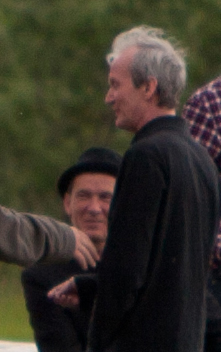
So this is my original picture - a shot of some friends at a gathering, somewhere up a mountain in Iceland. The POV (objective) gives out the possibility that this crowd is being watched, a possible drug deal or some dramatic underworld incident could be about to take place. The main protagonists in my story are: "Arlof" (Mr Big); "The Dane"; "Boom Boom" (The Dane's Lieutenant); "Mad Dog Sille" (The Dane's bodyguard). Other characters are Assorted Vikings and Arlof's Goons (all in uniform: black clothes, pork pie hats).
|
 |
| Frame 1: This is to ease us gently in to the scene - lull us into a sense that all is normal and jovial here. Assorted vikings are getting the BBQ up and running, drinking, chatting and laughing quietly. We can't see their faces but we don't know yet whether that matters or not. The BBQ fork behind the fence adds some menace but may just be a red herring... |
 |
| Frame 2: This is Arlof, Mr Big - the most powerful and dangerous man in Iceland right now. We pan in close enough to hear Arlof make a cruel joke at the expense of The Dane. We see one of Arlof's Goon's laughing to Arlof's right. |
Frame 3: The Dane, in an apparent attempt to diffuse the situation reaches over to Arlof in a "hey, show some respect!" gesture, also as a show of strength to regain face in front of his men
 |
Frame 4: The excruciating tension caused by the sneering laughter of Arlof's Goons is extended as if to taunt The Dane and his men to respond |
 |
| Frame 5: Boom Boom, the smiling assassin, leans back ready to grab his weapon when the moment comes. |
 |
| Frame 6: Unnoticed by the others, Mad Dog Sille (who is famed across Europe for being an ambidextrous killer) casually walks towards Arlof reaching for his knife, ready to stab Mr Big. |
Project: Building a story
|
So this is my original picture - a shot of some friends at a gathering, somewhere up a mountain in Iceland. The POV (objective) gives out the possibility that this crowd is being watched, a possible drug deal or some dramatic underworld incident could be about to take place. The main protagonists in my story are: "Arlof" (Mr Big); "The Dane"; "Boom Boom" (The Dane's Lieutenant); "Mad Dog Sille" (The Dane's bodyguard). Other characters are Assorted Vikings and Arlof's Goons (all in uniform: black clothes, pork pie hats).
|
|
| Frame 1: This is to ease us gently in to the scene - lull us into a sense that all is normal and jovial here. Assorted vikings are getting the BBQ up and running, drinking, chatting and laughing quietly. We can't see their faces but we don't know yet whether that matters or not. The BBQ fork behind the fence adds some menace but may just be a red herring... |
|
| Frame 2: This is Arlof, Mr Big - the most powerful and dangerous man in Iceland right now. We pan in close enough to hear Arlof make a cruel joke at the expense of The Dane. We see one of Arlof's Goon's laughing to Arlof's right. |
|
Frame 3: The excruciating tension caused by the sneering laughter of Arlof's Goons is extended as if to taunt The Dane and his men to respond |
|
| Frame 4: Boom Boom, the smiling assassin, leans back ready to grab his weapon when the moment comes. |
|
| Frame 5: Unnoticed by the others, Mad Dog Sille (who is famed for being an ambidextrous killer) casually walks towards Arlof reaching for his knife, ready to stab him. |
Sunday, February 17, 2013
Exercise: A story of my own


What is the story? This is the story of a man being unexpectedly eaten by an enormous shark, obviously.
What information is conveyed in each frame?
Frame one: small boat; man not expecting to be eaten by a shark (no evidence of guns or other protection); man relaxed - having a fag; calm water. We see the man's face so we can make an impression of him and care (or not) when he is eaten by the shark.
Frame two: enter the gigantic shark. The water is still calm implying the man is unaware - he is looking in the other direction. We are reminded that the boat is small by the aerial view.
Frame three: this was designed to highlight the horror of the man's last moments - we are placed just behind his recognisable red ball cap (very subtle, aren't I?) as the shark approaches. The speed of the attack is emphasised by the sudden cut from the aerial view in frame two.
Frame four: some general chaos and splashing around to make this seem slightly more plausible than if the shark just stealthily stuck its head over the boat side and scoffed the man. Again re-emphasis on the contrast in size between boat/man and shark - a sledgehammer metaphor for how helpless humans are against nature (especially impossibly large sharks). The red cap is there so the man almost certainly has not escaped (although it probably should have been eaten too).
Frame five: all is completely calm again. The shark has moved on and all that remains are the eerie signs of the presence of the man - the upturned boat (maybe should have had a big bite mark down one side?), the cap (which is actually getting on my nerves now) and the rod - leaving the possible interpretation that this is a lesson: if you go hunting (fishing), prepare to be hunted...
What information is necessary to understand the story? I think I have covered the key elements. We may wonder how far the man was from land, how deep the water is, how the shark got to be so bloody big, why the hat survived and the boat is undamaged but none of these things are essential to the basic story.
What essential information has been left out and/or what is included unnecessarily? Not entirely sure frame four is necessary but it may seem a bit too dramatic a change in tempo without it.
Saturday, February 16, 2013
Exercise: Telling a story
The aim of this exercise is to tell a story
in just five frames. I tried to think of
something a bit more creative than following the suggestion of using a
fairytale. Some of my ideas were a bit obscure though and I figured that the
main aim of this exercise is to focus on choosing the key narrative elements
from a known story so a fairytale seems like as good an option as anything.


This was a very interesting exercise - thinking about key elements such as the depiction that she is a haughty princess, that she is dissatisfied with her suitors and so on. I also had to alter the content of the frames to overcome the limitations of my appalling sketches (ie placing the prince on the lily pad so it is obvious that he is a transformed frog). Some key information has had to be omitted such as how/why the prince was a frog in the first place but I guess that adds some mystery...
Is it obvious what the story is?
Does each frame convey some new information?
Is it the right information to understand the story or is something missing?
Has anything been included unnecessarily?
Could my sketching and colouring possibly be any WORSE?
Is it obvious what the story is?
Does each frame convey some new information?
Is it the right information to understand the story or is something missing?
Has anything been included unnecessarily?
Could my sketching and colouring possibly be any WORSE?
Monday, January 28, 2013
Review of Django Unchained
Warning: may contain spoilers…
I am a Tarantino fan, with a love of
spaghetti westerns, and so had high expectations for this latest creation. I confess to being worried however about the horror of the subject matter and by the time we were
in our cinema seats was anxious about how violent
the movie might be – it has been a while since I saw something like this on the
big screen.
In the end I only had to shield my view
during two scenes (the dog attack and the Mandingo fight) and I thoroughly
enjoyed pretty much every other moment of the film (which ran to nearly three
hours). It would have been hard to see
where this time could have been cut down.
The director makes every moment of the film work hard. There were some rumblings about this
production suffering, as it is the first of QT’s feature films not edited by
Sally Menke, but I found it to be very impressive and certainly on a par with
Pulp Fiction and Inglourious Basterds (which I adored).
There is masses of laugh-out-loud humour
and Christopher Waltz’s character is so charming that it makes for an easy
watch. Jamie Foxx takes a while to grown into his part but this may have been
deliberate as it builds to a fantastic climax and leaves the viewer feeling
exhilarated and satisfied with the turn of events. Visually gorgeous but without the
cinematography distracting from the story development.
I was relieved to find Tarantino does not
exploit the violence of slavery – to me it seemed he showed just
enough to convey the atrocities and injustices but without ever wallowing in
it. Even the excessive use of the N-word
was not as troubling as I had feared – it just serves to illustrate how
commonplace and ludicrous it was in that era.
My only real criticism would be the
weakness of the female characters – they were mostly inconsequential, including
the mysterious woman tracker with her face covered by a bandanna. I also thought the ‘dream’ sequences, where
Django sees Broomhilda in his mind, were pointless – they did not add anything
to the narrative. I worried that QT may
be showing us Django’s wife as he remembered her because we were about to see her after being brutalised and physically damaged. When we do finally meet her though, there is
not even any sign of the bramble scratches that Stephen refers in the scene
outside the Big House.
Di Caprio is superb in the role – his baby
face a reminder that he is third generation in the plantation and still apt to
make mistakes, needing Stephen’s guidance to identify the deceit of the bounty
hunters. Stephen, played by Samuel L
Jackson, is one of the best film baddies imaginable. The close up of his face as he reacts to
seeing Django ride up to the house is quietly terrifying, even before we have
any inkling of how dangerous he is.
All the main (male) characters are complex
and convincing with the only bit of bad acting being a cameo from Tarantino
towards the end. We even get to see
Franco Nero, star of the 1966 Corbucci film Django, inspiration for QT.
IMDB details lots references, many of which
I am not familiar with: http://www.imdb.com/title/tt1853728/trivia?tab=mc#references
It also lists a number of anachronisms and
geographical “goofs” which one can only presume a moviemaker of Tarantino’s ilk
was aware of - and decided to gloss over - or that were deliberate (e.g
Stephen’s rants including the use of “motherfucker” several times).
Other fun touches include Broomhilda and
Django being ‘von Shaft’ – great great great grandparents of John Shaft; a
Wilhelm Scream (when the Regulators are retreating from the explosives on the
wagon); the wobbly tooth on top of Shultz’s wagon; trademark close-ups of feet
and even some laughs during the penultimate bloody shoot-out. The eclectic soundtrack does not disappoint either
(Morricone meets horror-core hip-hop).
This is a rich and rewarding film that
stays with you for days after viewing. Priceless
Tarantino: epic movie making at its artistic and wittiest best.
And here is a proper review (which I wish I
had read before starting my amateur attempt but I am pleased to see covers some
of my broader points):
Subscribe to:
Comments (Atom)